For aspiring entrepreneurs seeking to validate a business idea, this ranked guide presents the top five strategies to test your concept before significant investment. Validation—the crucial process of gathering evidence to prove a concept has real-world potential—is the next essential step after developing an idea. This list guides founders from initial research to securing their first paying customer, ranking strategies based on their increasing level of commitment and real-world proof.
This list was ranked based on each strategy's escalating level of external validation, moving from initial low-cost research and qualitative feedback to definitive, revenue-backed market commitment.
5. Leverage AI for Rapid Market Analysis — Best for Speed and Accessibility
This is your first move. For the entrepreneur with a fresh idea scribbled on a napkin, leveraging artificial intelligence is the fastest way to get a directional sense of the market. Before you spend a single dollar on development, you can use AI tools to gauge viability. According to a report from Entrepreneur.com, AI has drastically shortened the timeline for business launches by making it possible to analyze trends, search demand, and competitive landscapes almost instantly. This strategy is for the founder who needs to move quickly, test multiple concepts, and make data-informed decisions from day one. It allows you to ask big questions and get immediate, quantitative feedback on market size, audience demographics, and keyword popularity.
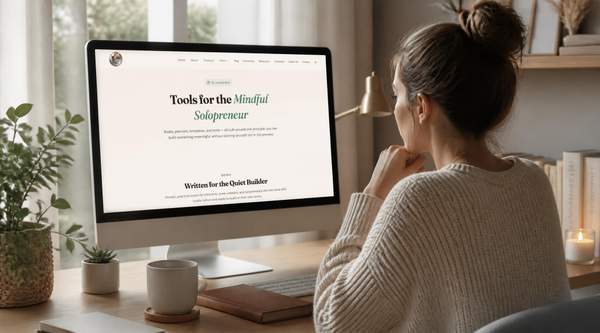
This method ranks above traditional, manual Google searching because of its sheer speed and depth. While you could spend weeks sifting through articles and reports, AI synthesizes this information for you. The same report from Entrepreneur.com notes that AI allows founders to refine ideas with data-backed insights before investing significant time or money, which reduces the risk of building something nobody wants. However, its primary limitation is a lack of qualitative nuance. AI can tell you what people are searching for, but it can't tell you why they feel a certain pain point. It's a powerful starting point, but it's not the whole story.
4. Conduct Deep Competitor Research — Best for Strategic Positioning
Once AI provides a broad market view, zoom in on specific players in your field. This strategy is for founders who have confirmed a general market need and now must determine how to stand out. It involves deconstructing competitors' entire strategies, not just identifying them. According to SCORE.org, researching if a similar product or service already exists is a foundational validation strategy. Go beyond a simple list: sign up for their newsletters, follow their social media, read customer reviews (especially negative ones), and analyze their pricing models. Your goal is to find the gap—the unmet need, the underserved customer, or the frustrating feature—that your business can uniquely solve.
This deep dive provides a strategic roadmap that broad market analysis can't. It helps you define your unique value proposition and avoid making the same mistakes as established players. By understanding their weaknesses, you discover your potential strengths. The main drawback of this approach is the risk of "analysis paralysis," where you become so consumed with research that you fail to take action. It can also tempt you to imitate rather than innovate. Use competitor research to inform your strategy, not define it. Your unique vision is still the most important asset you have.
3. Seek Brutally Honest Feedback — Best for Early Qualitative Insight
While data reveals "what," it often fails to explain "why." This is where the human element becomes crucial. For entrepreneurs with a defined concept, wireframe, or basic prototype, this strategy involves sitting down with people and listening to understand the user experience on an emotional level. Early feedback is a gift, despite the temptation to keep a brilliant idea under wraps. SCORE.org suggests seeking honest feedback from friends and family, especially with a prototype, as a valuable way to validate an idea. The key is to hunt for criticism, not praise.
This method ranks higher than pure research because it provides raw, unfiltered human insight that uncovers usability flaws and emotional triggers that data sheets will never reveal. It’s in these conversations that you’ll hear things like, "I don't understand what this button does," or "I would never use this because..." This is pure gold. The most significant limitation, however, is bias. Your friends and family love you and may not want to hurt your feelings. To overcome this, frame your questions carefully. Don't ask, "Do you like my idea?" Instead, ask, "What is the biggest problem with this? What would you change? Why wouldn't you use this?" To truly cultivate a growth mindset, you must actively seek out the feedback that challenges your assumptions.
2. Launch a Crowdfunding Campaign — Best for Public Demand Testing
Ready to test if strangers will financially commit? A crowdfunding campaign is a powerful, public test of your idea's appeal. This strategy suits founders with innovative physical products, creative projects, or community-focused ventures needing both market validation and seed capital. Platforms like Kickstarter and Indiegogo serve as validation engines, not just fundraising tools. You are asking for a financial commitment before the product is even fully built, not just opinions. According to SCORE.org, these crowdfunding sites effectively test product potential and raise money, particularly for new and innovative concepts.
A crowdfunding campaign forces you to build a compelling narrative, create marketing assets, and define your target audience with precision. A successful campaign is a powerful signal to investors, partners, and future customers that you’ve created something people genuinely want, validating demand on a scale that one-on-one interviews cannot. The primary drawback is its public nature: a failed campaign can be a significant setback, both financially and motivationally. It requires a substantial upfront investment of time and resources to create a high-quality campaign page, promotional video, and marketing plan. Success is not guaranteed, but the lessons learned—win or lose—are invaluable.
1. Build an MVP and Secure Pre-Orders — Best for Ultimate Financial Validation
This strategy is for the serious entrepreneur ready to move past theory and prove, with certainty, a viable business. It involves creating a Minimum Viable Product (MVP)—the most basic version of your product that still solves a core problem for your customers—and asking them to pay for it. Whether through a pre-order for a physical product, a paid subscription for a software beta, or a deposit for a service, this represents the ultimate test. As SCORE.org wisely puts it, the ultimate validation for a business idea is when people or businesses are willing to pay for the product.
This strategy ranks number one because it is the only one that definitively answers the most critical question: Will people buy this? It replaces assumptions with transactions. A landing page with a "Pre-Order Now" button that converts is more valuable than a thousand positive survey responses. It provides undeniable proof of market demand and generates your first revenue, creating momentum that is critical for growth and fundraising. The main limitation is that it requires the most significant upfront investment of time and resources. You have to build something, even if it's simple. The risk is investing in development before you're confident in the demand, which is why this step should follow the others on this list. Take the leap and ask for the sale. It’s the clearest signal you’ll ever get.
| Strategy | Category/Type | Cost / Commitment | Best For |
|---|---|---|---|
| Leverage AI for Rapid Market Analysis | Initial Research | Low (Hours) | Quickly testing multiple early-stage ideas for market viability. |
| Conduct Deep Competitor Research | Strategic Planning | Low (Days) | Finding a unique market position and value proposition. |
| Seek Brutally Honest Feedback | Qualitative Validation | Low (Days) | Uncovering user experience flaws and emotional hooks with a prototype. |
| Launch a Crowdfunding Campaign | Public Demand Test | Medium (Weeks/Months) | Validating innovative physical products and raising seed capital. |
| Build an MVP and Secure Pre-Orders | Financial Validation | High (Months) | Gaining definitive, revenue-backed proof that customers will pay. |
How We Chose This List
We selected and ranked these five validation strategies to create a logical, step-by-step roadmap for a first-time entrepreneur. The ranking criteria centered on the escalating level of commitment and the strength of evidence each method provides. We began with low-risk, internal-facing research (AI and competitor analysis) requiring minimal investment beyond time. The list then progresses to external-facing validation involving direct customer interaction, first with qualitative feedback, and then with real financial stakes through crowdfunding and pre-orders. We excluded purely theoretical exercises in favor of actionable strategies that generate tangible data and real-world feedback, equipping you with the confidence and proof needed to build your business on a solid foundation.
The Bottom Line
Validating your business idea isn't a single event; it's a process of building conviction. For entrepreneurs just starting with a spark of an idea, begin with AI-powered market analysis (#5) for a quick, data-driven reality check. For those ready for the ultimate proof of concept before seeking major investment, building an MVP and securing pre-orders (#1) provides the undeniable financial validation needed to move forward with confidence. Unlock your potential by testing, learning, and building on a foundation of proof.