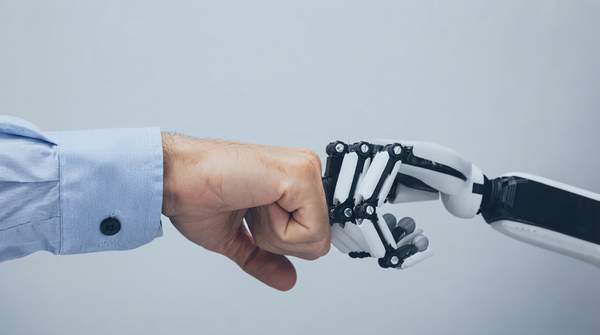
AI should take over the standardized, repetitive work; your people should keep the judgment, ethics, creativity, and accountability. That is the core decision leaders face, and it cannot be left to chance or to vendors. The guidance that follows turns expert thinking from Stanford's Graduate School of Business, Harvard Business Impact, and workforce researchers into a practical boundary leaders can draw deliberately.
Navigating the AI Era: A Human-Centric Approach to Leadership
AI raises the stakes for leadership rather than lowering them. Stanford's executive education faculty note that AI can accelerate decision-making, but it can also create a false sense of certainty, so leaders need a disciplined approach: understanding what AI can and cannot do, and clarifying when human judgment is needed to maintain ethical awareness and accountability.
Writing in Harvard Business Impact, Diane Belcher frames the relationship with a mountaineering analogy: AI is the expedition's gear—precise, powerful, and increasingly capable—but the gear is not the guide. The guide reads the mountain, adjusts the route to conditions, sets the pace, makes safety-critical decisions, and safeguards the team's resources, skills, and morale. Companies that succeed, she argues, won't simply be the ones with the most advanced tools; they'll be the ones that have deliberately elevated the human capabilities that give those tools purpose.
The AI-Human Task Decision Matrix
The most useful way to operationalize this is to sort every candidate task against three questions: Is the work standardized and repetitive? What happens if the output is wrong—how high are the stakes? Does the task require empathy, ethical judgment, or creative adaptation? The matrix below applies those criteria to the task types leaders encounter most often, distinguishing what AI can run, what it can assist with, and what must remain a human responsibility.
| Task characteristic | Best role for AI | Best role for people | Leadership principle |
|---|---|---|---|
| Repetitive, standardized tasks (e.g., initial CV screening, candidate assessment) | Run the process to ensure a standardized evaluation experience | Focus on qualitative assessment—cultural fit and long-term potential | Automate for consistency, but keep humans on the qualitative judgment |
| Complex, unexpected, or safety-critical decisions | Supply analysis, comparisons, and summaries as input | Make the decision—humans supply adaptability, judgment, and creativity technology cannot yet match | Reserve final judgment for people |
| Decision-making responsibility and accountability | Accelerate and inform decisions | Own the outcome—leaders must clarify who is responsible when AI is involved | Assign accountability explicitly; without it, teams risk overlooking errors or avoiding AI tools |
| Learning and skill development | Accelerate learning curves for less experienced employees when paired with coaching | Turn tool access into practical skill growth through structured feedback | Tools alone don't build skills; complements do |
The decision boundary that emerges is straightforward: the higher the stakes and the more the task depends on contextual judgment, empathy, or ethics, the stronger the human claim to it. The more standardized and repetitive the work, the stronger the case for automation—provided a person still owns the outcome.